
|9.32Mins Read
Random VIN Generator by Year and Brand: ISO 3779 Guide for Test Data in 2026
- Authors

- Name
- Geeks Kai
- @KaiGeeks
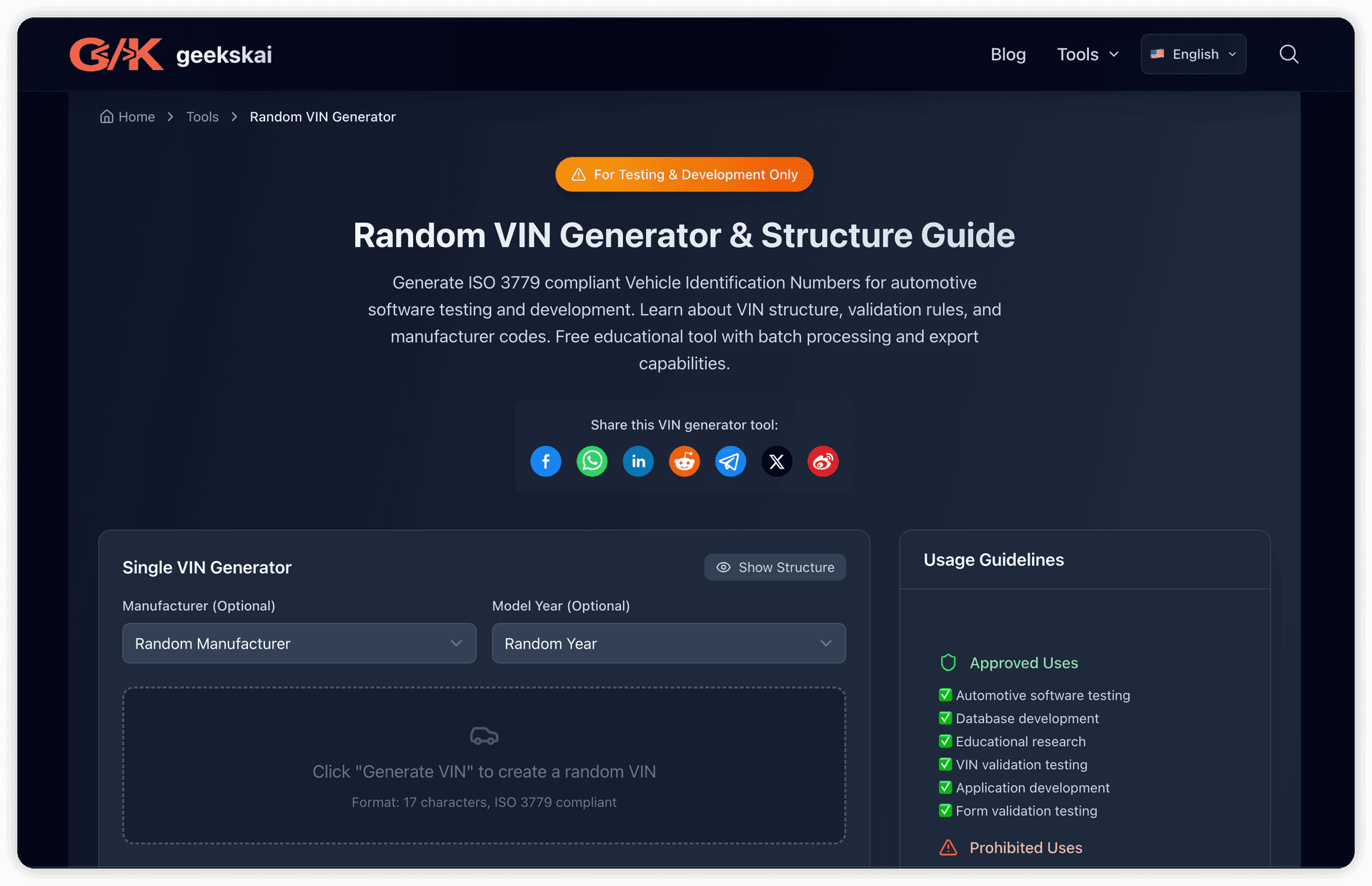
Quick Answer: A random VIN generator by year and brand creates 17-character test VINs by combining a manufacturer prefix, a model-year code, and a valid check digit. It is most useful for QA, development, demos, imports, and automated testing, not for registration or legal vehicle records.
Best for: Automotive developers, QA teams, fleet software testing, VIN parsing validation
Cost: The GeeksKai random VIN generator is free to use
Key benefit: It helps you create structured, brand-aware, year-aware VIN test data faster than building VINs by hand
A random VIN generator by year and brand helps you create synthetic VIN test data that looks like real vehicle identification data without manually assembling every character. That matters because VIN handling systems often depend on position 9 for the check digit, position 10 for model year, and positions 1-3 for the manufacturer identifier.
For authoritative references, the National Highway Traffic Safety Administration (NHTSA) states that a VIN is a 17-character identifier and provides a public VIN decoder plus a check digit calculator. ISO 3779:2009 defines the global VIN content and structure and recommends the year-code sequence used in common VIN generation workflows for 2010-2030.
A random VIN generator by year and brand lets you control the two fields developers and testers care about most:
That combination is useful when you need test cases like:
If you only need random 17-character strings, a generic string generator is enough. If you need VINs that pass parser checks, support year filters, or resemble a specific brand family, use a dedicated random VIN generator.
In practical VIN parsing, the most important positions are:
| Position | Meaning | Why it matters |
|---|---|---|
| 1-3 | WMI | Identifies the manufacturer or manufacturer group |
| 4-8 | Vehicle descriptor | Encodes vehicle attributes defined by the manufacturer |
| 9 | Check digit | Helps validate the VIN mathematically |
| 10 | Model year | Supports year-specific filtering and testing |
| 11 | Plant code | Indicates manufacturing plant information |
| 12-17 | Serial sequence | Distinguishes one vehicle record from another |
NHTSA's public VIN decoder and the U.S. regulatory VIN rules in 49 CFR Part 565 are the best practical references when you want generated VINs to behave correctly in U.S.-market software. ISO 3779 remains the core structural reference for the VIN format itself.
The check digit in position 9 is one of the biggest reasons to use a real VIN generator instead of manually typing sample values.
NHTSA's check digit calculator reflects the standard U.S. workflow:
If your application validates VIN input, a missing or incorrect check digit will usually break the test immediately. That is why a proper generator should calculate it automatically.
If you want a random VIN generator by year, the most important field is the recommended year code in position 10. For the years most teams test today, the mapping looks like this:
| Year Code | Model Year | Year Code | Model Year | Year Code | Model Year |
|---|---|---|---|---|---|
| A | 2010 | H | 2017 | P | 2023 |
| B | 2011 | J | 2018 | R | 2024 |
| C | 2012 | K | 2019 | S | 2025 |
| D | 2013 | L | 2020 | T | 2026 |
| E | 2014 | M | 2021 | V | 2027 |
| F | 2015 | N | 2022 | W | 2028 |
| G | 2016 | X | 2029 | ||
| Y | 2030 |
This sequence is consistent with the year coding shown in ISO 3779 reference material and with the model-year behavior you will see in VIN decoders. It is one of the simplest ways to generate targeted test data for reporting, search, sorting, warranty logic, and time-based rules.
If you want a random VIN by brand, start with the WMI. These examples are common starting points used in brand-aware test cases:
| WMI Code | Manufacturer | Country | Vehicle Types |
|---|---|---|---|
| 1FA | Ford Motor Company | United States | Cars, Trucks, SUVs |
| 1G1 | General Motors | United States | Chevrolet, Cadillac, GMC |
| 1HG | Honda | United States | Cars, SUVs, Trucks |
| 1N4 | Nissan | United States | Cars, SUVs, Trucks |
| 2C3 | Chrysler | Canada | Cars, Minivans, SUVs |
| 2T1 | Toyota | Canada | Cars, SUVs, Trucks |
| 3VW | Volkswagen | Mexico | Cars, SUVs |
| 4T1 | Toyota | United States | Cars, SUVs, Trucks |
| 5NP | Hyundai | United States | Cars, SUVs |
| JHM | Honda | Japan | Cars, SUVs, Motorcycles |
| JTD | Toyota | Japan | Cars, SUVs, Trucks |
| KNA | Kia | South Korea | Cars, SUVs |
| WBA | BMW | Germany | Luxury Cars, SUVs |
| WDB | Mercedes-Benz | Germany | Luxury Cars, SUVs, Vans |
| WVW | Volkswagen | Germany | Cars, SUVs |
These values are useful for testing, but they are examples, not a full manufacturer database. Many brands use multiple WMI codes across plants, countries, trims, and production lines. When exact decoding matters, verify against NHTSA's vPIC decoder or manufacturer-supplied VIN data.
Year-aware and brand-aware VIN generation is especially useful when you need to test:
Most generators support the same three export formats because each one fits a different workflow:
If the tool includes extra metadata like year, brand, WMI, or validation status, CSV and JSON are usually more useful than plain text.
Use these rules if you want your generated VINs to stay useful:
A generated VIN is safe for testing, QA, demos, sandboxes, and educational use. It is not appropriate for:
Treat generated VINs as synthetic test data and keep them separate from customer or production records.
If you want to validate your generator logic or improve your own VIN tooling, start here:
A random VIN generator by year and brand is the right tool when you need realistic VIN-shaped test data instead of arbitrary strings. The most important signals are simple: 17 characters, a valid WMI, the correct year code, and a computed check digit.
If that is what you need, the GeeksKai random VIN generator gives you a faster way to build year-aware, brand-aware VIN samples for QA, automation, imports, and development work.
A random VIN generator by year places the selected model-year code in position 10, fills the other positions with valid VIN characters and brand data, then calculates the position-9 check digit. That lets you generate VINs for targeted scenarios like 2018 decoder tests or 2025 inventory imports.
Yes. Brand-specific generation normally starts with the WMI in positions 1-3. Common examples include Ford, Toyota, Honda, BMW, Mercedes-Benz, and Volkswagen prefixes, though exact codes vary by region and plant.
A VIN generator aligns with ISO 3779 when it follows the standard VIN content and structure, including correct section layout, valid characters, and proper year coding conventions. For U.S. validation flows, the check digit and NHTSA decoding behavior also matter.
Yes, for testing, development, QA, demos, and training. No, for registration, insurance, title work, or legal paperwork. Keep them in non-production datasets whenever possible.
Most batch VIN generators support TXT, CSV, and JSON. Choose TXT for simple lists, CSV for spreadsheet review and imports, and JSON for automated test fixtures and API workflows.